Thursday, 7 August 2008

4 Months on...

It's strange. I remember leaving the UK like it was yesterday. I know it was only 4 months ago, but my memory is very bad generally so remembering an event clearly is not something I'm used to. Waking up early. Making my last preparations before going up to catch the bus at stupid o'clock in the morning. Saying goodbye to my Mum and Dad. Sitting on the bus in Plymouth and getting worried about the amount of snow starting to fall. Reaching Reading and the motorway being at a standstill. Worrying about missing my flight. The relief of reaching Heathrow in time. Running and jumping onto the trolley in Heathrow, just missing the old man with walking stick before, with great skill and dexterity, jumping off and catching the trolley before it crashed into the wall. Meeting my sister in the terminal and checking in. Saying goodbye to her at departures. And in the queue realising what I was doing - it hit me like a salmon in the face.

So, in 4 months what have I done. Well, not much to be honest. I've learnt quite a lot about how things work with NGOs, which I was completely ignorant of before coming here - a big mistake. I've also improved my Nepali a lot. I can understand quite a lot now, and even have conversations with strangers which is fun. I still can't quite understand the TV or songs, those words a bit too quickly for me and are usually complicated. However I'm getting better at reading the ticker going along the bottom so can tell when people die in bus crashes or the parliament is meeting to resolve the latest crisis in Nepali politics. The good thing about doing nothing is I haven't invalidated my visa, which they have just doubled in price to my surprise.

I've also learnt a lot about myself, something I didn't really expect as I thought after 26 years I knew myself quite well. Some things I'm not so happy about so will definitely have to work on. Others aren't that bad qualities to have. I've found I've inherited a something from my Grandad. Unfortunately it's not his amazingly big hands, skill as a carpenter or ability to grow a most beautiful garden. I've become a hypochondriac. I have so far self diagnosed myself with appendicitis, bronchitis, giardiasis, worms, ear infections, conjunctivitis to name a few and become very paranoid about every little bump and lump I find - especially on my head. Of course, all of these lumps are potentially fatal. But to be truthful, the only thing I've really suffered is the traditional travellers stomach problems, and none of them have been that serious - especially compared to the second time I came here, I had stomach acid coming out and couldn't stand up by myself, so had to be carried for 2 km to a friend's house.

So, the report card would probably say:
"Could do a lot better. Must work harder. Stop obsessing on health and staring at navel. Promising prospects ahead if you put your mind to it."


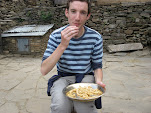
Me, after 4 months of Nepal

(I know I haven't shown many photos of me for a long time, partly because I don't like photos of me, but mainly because I had a insect bite the size of Mount Everest on the end of my nose, which wouldn't go away. It probably sounds quite vain and is, but hey.)

The final approach into Kathmandu airport is fairly tricky, you descend over the mountains surrounding the valley and duck down below the peaks before landing. Sometimes the valley floor is hidden beneath the morning mist or afternoon pollution cloud. More recently the evening flights have faced another problem - kites. As I understand it's not as popular as in Pakistan or Afghanistan, but in the evenings there are still several hundred kites flying from the roofs the houses here. These kites don't fly just 20 or 30 metres above the ground, they can go several hundred metres up. The other day a kite from a house near ours got caught up in the turbulence from a small shuttle aircraft approaching the airport. What would happen if the aircraft actually flew into a kite? I guess very little, 5 rupees worth of plastic and bamboo wouldn't be able to take down, but I can imagine it would be fairly scary for a pilot to see one of the kites passing his cockpit window. Anyway, these kites are flown as high up as possible with mock battles taking place, young vs. old, everyone vs. foreigner, the usual. At home, I would like to think I'm a fairly competent kite flier, but all my kites have 2 or 4 lines, providing ease of control. However, these are single line kites, and controlled by pulling the string when the kite is facing the appropriate direction. I can't seem to tell when the kite is pointing the direction I want it to go in, and so it generally tends to plummet from the sky every time I take control. The nearby army camp has gained a large number of kites!

I don't know how many people have been watching the news and have seen the stories from western Nepal, but the World Food Program and other aid agencies say that there are almost 2.2 million people in the remote hills that are starving. The price of food has obviously risen worldwide, the increase in the price of petrol has caused further price increases for those dependent on buying in food, and landslides have made many roads impassible even with tractors. Can I ask everyone to pray that a solution is found soon before these people starve to death. This should not be happening in a world with plenty.

On a bit of a happier note, today is Nag Panchami - a festival to appease the snake spirits. So this morning, Aama, Achut and Rachhu stuck up pictures of snakes with cow dung on the entrance to the house, before doing puja. During the puja, the picture of the snake is covered with milk and water, grass is put on the top of the picture, then large quantities of sindur powder is applied to the picture.


The puja-ed snake picture

Apparently this is also the day to clean your well. Wells are the traditional home to snakes, but on this day snakes are off visiting their relatives so you are safe to clean your well. A bit like Boxing day in the UK. However, I don't think I'd like to find the well where all the snakes are visiting their relatives in...

A Gaine (said guy-nee), traditional Nepali wandering minstrel, has turned up to our house and has been playing Nepali folk songs whilst I've been writing. The sound of the chords playing on the sarangi, a Nepali violin type instruments, and the Gaine's whining melodious voice brings everyone in our road out onto their balconies to listen. He sings a song or two, I think they are sad, as his face has a pained expression on it and the audience remains quiet and contemplative. He then asks for some money, and receives a few rupees before wandering on to the next road. The joys of living in Nepal.

I'm off to see some micro-hydro projects on Friday or Saturday with a friend - was supposed to be today, but this is Nepal - and so shall be away for a week or so. I'm really looking forward to getting out of the valley and visiting another rural village. I'm not quite sure how things will go, it's one day walk from the nearest bus stop and these people won't probably have seen too many white people before.

Fun fun fun

SAM

Tuesday, 5 August 2008

A Birthday Party

Yesterday I was invited to a birthday party for a 3 year old little girl, Parisma, who lives in the house opposite us. So at the appointed hour Bhanja and I went. The family are an ex-British Army family, one of the many in our locality. However, Parisma's father is now in the Indian Army and currently stationed there, and mother is in America, so Parisma lives with her Grandparents.

Just as we walked across the road we heard Happy Birthday emerging from the house, and knew we were late. When we arrived, we were led into a room. There was Parisma stood behind a table. She was wearing a new dress sent from the UK, a cardboard pointy hat and a pair of Elton John-esque glasses. Her eyes were burning bright, looking around her at all the attention she had, confused yet enjoying it. On the table was a large plate of apples and bananas - prasad, an offering blessed during puja - one apple had 2 burning incense sticks stuck in it, a birthday cake already cut, and a small plate of rice and curd to be used later for tikas.


I was guided to a seat whilst Bhanja was given a pair of the Elton John-esque glasses and sat with the other children already there. On the chair next to mine was a pile of presents, to which ours was added. In my pocket was 50 rupees to give to Parisma as adults generally give money, not presents. Soon, one by one starting with her Grandparents, people came up, gave themselves a tika from the small plate and gave Parisma a tika before giving her their present and having a photograph. At this point I got concerned. I was going to be expected to give Parisma a tika, as well as myself. I had never given anyone a tika before in my life. The other matter of concern was that everyone seemed to be giving at least 100 rupees. As discretely as I could I pulled out 100 rupees from my wallet, and swapped it for the 50 note in my pocket.


My turn arrived. My heart was beating fast. By now, a small mountain of presents had built up on the table, and the tika on Parisma's forehead was threatening to feed a small nation for the next month. I asked Parisma's uncle to show me what to do, as I thought that would provide a good excuse for being lame. So he showed me. I gave myself a tika, missing the centre of my forehead, the traditional location for a tika, instead locating it just over my right eye. Then I knelt in front of Parisma and tried to give her a tika. However, the best I seemed to be able to do was to knock off a large part of the tika already on her forehead. Great. With the remaining rice that had adhered itself to my fingers, I sprinkled over Parisma's head, and then handed her the money. Our photograph was taken, and I returned to sit on the ground.


At this point Parisma's grandfather started to talk to me, just as a girl entered the room. "You see her," he said to me, "she's very clever. Just finishing a BS [Bachelor of Science] in Nursing. Works very hard too." I could tell where this was going. The next thing that would come is something about her being very pretty, didn't I agree, and not married yet. However, I was truly saved by the bell, as the phone rang, and Parisma's grandfather answered the phone. Soon after, the food was served and a huge variety of Nepali curry was put on a plate for me, along with some apple, banana and a piece of the cake. An interesting mixture. As I ate, following Nepali custom, my plate was filled several times more with other curries. I ate, drank and made polite conversation - my parents did a good job - and learnt quite a lot about all the people in the room.


After eating more than my fill, I was led upstairs where it was a bit cooler. In my previous 3 trips to Nepal I had never visited this house, although it is just across the road. It was strange to see our road from a slightly different angle. I felt enlightened, looking at the world from a different point of view. The house that had looked at for many hours from ours I was now stood in. I could see our house, a drab, concrete grey building with the sun setting behind it, giving the only colour to the scene. I could see the houses that were hidden behind Parisma's house, normally obscured from view in our house. These were slightly dirty, one or two floor houses that the light of day rarely entered due to large amount of 3 and 4 floor houses surrounding them, victims of the lazy Nepali town planning laws. Normally houses are built within a compound and built to within a metre of the land, trying to make the most of the available space. However, this leads to many houses loosing natural light, as you can reach from one house to a neighbouring house with ease.


After an hour, we were called back down again and once again food was served. I had no space left inside and a pained look appeared on my face. I reluctantly accepted my fate, as I knew I wouldn't be able to win if I said no to the food. Somehow I managed to avoid people adding food to my plate. Maybe they could see me struggling, and my quick response to the offers was an indication of how I felt. Parisma's grandfather started to talk to me again. After a few minutes chatting about his family and mine, the subject once more went onto weddings. I think someone had asked him whether I was married - a standard question in Nepali society, along with age, caste and education. I didn't quite catch everything that was said, but it was along the lines of needing to arrange me a marriage, I was getting quite old to remain single. Everyone laughed. I decided, as I do in these situations, to keep quiet and look embarrassed. Keeping quiet out of choice, looking embarrassed not as much. Once again, I was saved. Aama called from our house, saying it was time we should return. So we thanked everyone, and made our way back to the house.

Parisma and her Grandfather (December 2007)

SAM

Tuesday, 29 July 2008

The President's First Engagement

So, Nepal's first president was elected by parliament, 2 days after it was supposed to be, but this is Nepal. Things move slowly. However, during the inauguration the Vice President took his vows in Hindi, a move that has caused strikes and unrest across the country since. To give an idea of the insult that this caused the Nepali people, imagine Winston Churchill giving his first speech after the Second World War in German. Yesterday I went into Kathmandu, and protesting bus drivers, taxi drivers and lorries were all parked the wrong way along the huge one way system in the middle of the city, forcing most of the traffic in the area to a standstill. Add to the that mile long queues for petrol that cause traffic chaos anyway, and Kathmandu was just impossible to move in.


Bikes queuing for petrol - One man told me he was expecting to wait 3 or 4 hours. After him, the queue still stretched another half a mile.

But anyway.

The President's first formal engagement as Head of State was to attend the Bhoto Jaatra, a festival the King of Nepal previously would attend. During the day the Raato Machhendranath, a chariot with a tall spire of wood, is pulled by devotees and tourists from Lagankhel to Jawalakhel roundabout, a distance of about a mile or so. On one occasion a few years ago the Machhendranath collapsed killing 4 people on this journey. Fortunately this time all went well. At Jawalakhel the crowds gathered. The police were making their presence known with several hundred holding back the crowds and others walking round in riot gear and carrying large bamboo poles, ready to beat anyone who steps out of line. At the foot of the Machhendranath a welcome party consisting of local dignitaries, the Scout groups from the private schools in the district and a band all dressed in white. Suddenly in a flurry of car movement, the Presidential cavalcade entered the roundabout and a huge round of applause erupted from the crowd. Nepalis were keen on embracing their new found democracy, even if some members of it were culturally inept. With the president and vice president stood the Army chief and former temporary Head of State, G.P. Koirala, showing his stubbornness and unwillingness to relinquish power quite yet.


The Machhendrath at Jawalakhel


The President and friends


After the traditional speeches, which no-one except those near the stand could hear, the band stuck up. And then the main part of this festival. The first VIP climbs up onto the Machhendranath, climbs onto the corner railings and hold out a jewelled vest. The crowd cheers. Then the VIP moves on to the three further corners before passing the vest onto the next dignitary who does the same thing. This is repeated several times for each dignitary. At one point, one of the VIPs fell off the railings into the Machhendranath. This was greeted by the crowd with laughter, after realising that he wasn't hurt. However, if he had fallen the other way, a drop of 2 metres would have greeted him, and a solid concrete floor.


Posturing on the Machhendranath

Once all the posturing had concluded the President was whisked off again in a melee of flashing lights and sirens. One of the two Machhendranaths were left at Jawalakhel to be dismantled, whilst the other was again pulled towards Lagankhel, and then out of the city to a small village 3 miles from the Ring Road. Accompanying the Machhendranath on it's final journey of this year were hundreds of people, singing, dancing and enjoying the festival. This whole festival is to worship the Kathmandu Valley's rain bringing God, and this year it obliged us in the evening with a torrential downpour lasting several hours that threatened to leave several parts of this ancient city under water.


Pulling the chariot from Jawalakhel


All of this I saw with great ease compared to most Nepalis as I have a slight height advantage over them. I did feel sorry for those behind me, but only for a second. I think I'm turning into a...

SAM

Friday, 25 July 2008

Saun Arrives

Last week we celebrated the festival of Saun Sankranti, the first day of the Nepali month of Saun. Achut raced off to temple at Pashupati, the most famous in Nepal, to get some offerings blessed, and returned with mallas - necklaces - and sweets for us. Saru, who had been staying for the previous few days, was also at the house and her husband also came along for breakfast. Although officially you're not supposed to cut your hair in Saun, which must kill a hairdressers trade during the month, I still got my hair cut as it was starting to look rather unwieldy. Girls also traditionally wear henna during this time, which always makes me double take. It does look amazing though.


Henna decorated feet

It was great to see Saru again for those few days. Every time I had come to Nepal before, she was always in the house. It does seem a bit quieter without her. So when she is allowed by her husbands family to visit, the house becomes slightly more alive. However for me things get a bit quieter as everyone is talking to Saru, which I don't mind at all. Sometimes though, when everyone is talking a different language and laughing you feel that they're all part of a club which you're not allowed in to. But it's not that I'm not allowed, I just don't understand yet. So, I've been working harder on my Nepali language over the last few weeks, trying to get more fluent. I am managing to understand more, however speaking is still a bit of a problem. The answer to this is practice, I know, and confidence. It's a matter of get confident stupid.

In 2 weeks I'm going to be heading out to see some projects run by some friends and see if they have any bright ideas. I've also been working on a website for someone else, which has been fun, as it's something else to do with my time.

One great thing about Asar, the previous month, and Saun is mangoes. All over the streets are mango sellers, selling mangoes for 30 rupees a kilo - about 25p. Someone also sent 10 kilos from the village, where they're abundant on the trees, so this means by the time I return to the UK, my mango habit is going to be an expensive one. The thing about Nepal is it's like it was in the UK 30 or 40 years ago. Each fruit has its season, and once it's finished for the time you can't get it. Which makes each time of the year special in its own way, and I like this. It makes you appreciate everything a little more. However, I'm going to miss not eating the mangoes.

And on the subject of food everyone has been hearing about the world food crisis in the news, and feeling it a little when shopping, but I thought I'd give you an example of how it's affecting people here in Nepal. The average Nepali wage is a dollar a day - equivalent to about 70 rupees. So over a thirty day month that is 2100 rupees. The house I live in earns about 9000 rupees a month, which is over 4 times the average. (Just as a quick thought - there are quite a few people that earn over the average wage, so conversely there must be a lot of people earning less than a dollar a day.) Even though the house earns well over the average, and for a Nepali family it is not that large at 6 people, almost all the 9000 rupees are spent on food. A 30 kg sack of rice - the Nepali staple and a synonym for food in the Nepali language - costs about 1000 rupees and lasts 20 days maximum. Then there's the vegetables, spices and other items that need to be transported into the valley and so the prices have gone up with the fuel price increase. How people are surviving on 2100 rupees I don't know. There are rumours that many places in the country only eat one time a day. This not only causes hunger but reduces the ability of people to work as they just don't have the energy from lack of nutrition, so they can't grow the food and so further rely on World Food Programme handouts.

So, we'll see how everything goes over the next couple of weeks, and see how far forward things can move in terms of work. Being positive.

SAM

Sunday, 6 July 2008

Solutions

Firstly I know I haven't updated for a long time. There's been a slight technology problem over the last few weeks. So, today I've put up three!

Tomorrow will be 3 months since I arrived in Nepal. To be brutally honest, I'm disappointed with my own progress. I've become rather despondent over the last few weeks. But now, I have an idea. A new question for myself. What can we do for no money at all? What projects can we start with willing volunteers, which we apparently have some of, only? Yes, the health post still needs to be built - especially now the Maoists are spreading rumours around the village that we're "eating" the money for it. But is there anything we can achieve for no money at all? And I think there is plenty.

So, the action plan is going to be made, a positive outlook to be taken, and we'll see how we go!

SAM

Crisis

You know how it goes. You lie awake at night, your mind racing with the thoughts of the past few days, critically reviewing every little decision made. Where could it have all gone so wrong? Why did you decide to get the new job / buy that house / marry that woman / go to Nepal for a year? Everything was fine before, why did you feel the need to change things, why now and not after 10 years? You knew it would be hard but surely not this hard, this is just impossible. And just like that your confidence crumbles like a cliff on the east coast of England.

Guess what? I'm going through a bit of a confidence crisis.

As I said before, I'm struggling to get funding for the first project. There is a way, I know it. I'm just getting a bit hacked off with all the closed doors. I knew it wouldn't be easy, but still, maybe I'm out of my depth.

So, I've decided to go and work with some other NGOs, understand how they work and see how they get things going. Also, if I help them, they've said that they'll help us - tag projects for us onto their larger ones. So. a back scratching operation is going to be underway soon.

As for everything else here, the Kathmandu Valley and most of Nepal has been stopped for the week or so. As I said a few weeks ago, the government put up petrol prices by 25%, so the transporters - buses, microbuses and tempos - decided to put their fares up by 30 to 40%. The government said no. So they went on strike. Also, other smaller things have happened, like a local council worker getting locked in the toilet by a forestry department official - funny but caused tyre burning and no traffic along the ring-road. Some people complain that when one or two people are unhappy then the whole country stops. And it's true. The schools are closed, many shops and offices shut, the roads are barricaded by agitators. Whilst all this happens, the police stand by and do nothing. The agitating group hold the government to ransom until they sort out their problems.

But how can the government solve them? For example, petrol prices rising. The government, like many others in the region, were subsidising petrol to encourage growth. However due to the rapid rise of the price of oil, the national oil company was building up huge debts. Now, if the government kept the petrol prices the same, then these debts would become unmanageable and the government would have to spend a large part of their small public finances in subsidising fuel to the detriment of other essential development activities. They are in a no win situation.

I get severely irritated by strikes. When I lived in France, French truck drivers blockaded Toulouse airport and our office because they weren't able to drive into the UK due to Foot and Mouth. What could the French Government do? The thing that annoys me most is here in Nepal, it is detrimental to everything people are trying to do to improve things in Nepal. The schools are shut, so the children can't go to school. The roads are blocked, making trade difficult from the fertile Terai to the valley and beyond. Also, tourists can't get around as easily and are put off - a couple of days ago 6 buses carrying tourists from Pokhara to Kathmandu were attacked by people on strike.

I realise the benefit of strikes and protests. The protests here 2 years ago brought the new found democracy and the end of the Nepali monarchy - a good thing or bad thing depending on your way of thinking. People have attained better working conditions and allowed a lot more equality in society because of them. But there must be a better way sometimes than holding the whole country to ransom until you get what you want. Even if it is just one day off work.

We'll see in the next few days how things go, and see whose crisis solves first.

SAM

And here's a picture of a mountain for the person who keeps on asking for them - it's Machhapuchhre (fishtail) in the Annapurna region. It's from last time I was there - it's been a bit tricky to visit the mountains recently!

A Trip to the Border

We slice through a line of trucks and people, weaving as is customary through Nepali traffic, and come to a gate. The gate on the road is shut, but the pedestrian gate is open. Through the gate and past the armed police, people are milling around. We ride through the gate and finally have to stop when there is no more space to ride in. In front of us we see some Chinese border guards, and the bridge - known as Friendship Bridge - one of the few crossings through the Himalaya. Suddenly, up rushes a rather concerned man and asks me what country I'm from. Out of the corner of my eye I see the Chinese border guards notice me - I suppose I'm not so difficult to spot being a 6 ft 3 white man in a country of short, dark skinned people - and start to walk towards me. Achut talks to him and explains, then suddenly he takes my arm and strongly guides me back to where we had just come from. The Chinese behind us speed up, and as I reach the gate they can't be more than 5 metres behind me. The man keeps on pushing me down the road until we reach a building. Achut is keeping up behind us, trying to talk to the man and find out what's happening. Once the man stops he talks to Achut for a few minutes, and then tells me I can't go past the building. I look up. The sign says "Department of Immigration, Tatopani". All is then explained. Apparently I left Nepali soil for a few minutes, the Chinese were looking to either let me through the border or arrest me. I almost caused a diplomatic incident. How exciting.

OK, I realise it was probably a bit silly and should have read a little about the place first before going there to find out what's what, but still, I would have thought that the half a dozen policemen guarding the gate should have stopped us coming through.

It was Achut's idea. Well, Achut or one of his friends. The border with Tibet is only 100km from Kathmandu, but still takes a good 4 hours on bike due to the state of the road. I had a feeling the trip would be all about Achut and his friends taking pictures of themselves, not something I particularly care for. And later as we set out being told that we would only spend 20 minutes at the border as there isn't much to see didn't put my mind at ease any more.

For the few days before we left, I kept on being quizzed by Aama: Were we going to do the bungee jump? This is the only jump in Nepal, from a rope bridge into the Koshi river below. I said I didn't know. What followed was a series of stark warnings if I were to jump, the stories of the people that have died and the usual niceties. I had wanted to do the bungee jump after being a wimp in New Zealand. However, to be diplomatic, I said I wouldn't.

We woke up at 3.30 am, we had to leave by 4 o'clock to make sure that we got there and back again before nightfall. The sound of the rain on the window was of great comfort to me. We won't go. So, I went back to sleep. At 5 o'clock I was roughly shook by Achut. Time to go, the rain had stopped and we had to meet up with everyone in 10 minutes. I groaned, partly from laziness and partly from resignation; we would be going. We met with Achut's friends and then followed the usual Nepali procrastination, involving tea, people being late and general nothingness. We finally left at 6.30, two and a half hours after we meant to.

We left Kathmandu, but not an hour into the ride the first problem happened. We lost one of the bikes, they got a puncture. So, the bike limped to the nearest collection of houses where there was a bike repair station. The puncture took nearly 2 hours to fix, during which time we had some food and I got extremely bored. And we were off again. The time was 9.30, now four and a half hours later than planned.

The Road to the Border

The road was stuck to the side of the mountains that surrounded us. All the way along the road, landslides littered our path, forcing us to crawl along long parts of the road. The scenery was amazing. This time, at the beginning of the rains, is the time of dhan - rice. Firstly the rice is planted in a small field, a nursery almost, before being transplanted into the paddy fields. The nurseries were an intense green, luminous against the dull green of the weeds in the mountains behind them. Surrounding these were the prepared paddies, dark brown with mud and flooded with water, ready for the dhan.

Achut the Model

There is something that puzzles me when I travel around Nepal. When you are driving along a road, no house, settlement or anything visible or within a few miles, there are always 2 or 3 people sitting by the side of the road. No sign of how they got there, no sign of how they were going to get back again. One time we were coming back from Rajghat, there was a large group of 30 or 40 people walking along the road. We passed the last house maybe 5 miles before. And as we rode past, there was not a house or building for the next 7 miles. Where did they come from? Where were they going to? Were these just figments of my imagination trying to overcome the pain in my rear end from sitting on the pillion for the previous 3 hours?

The Mighty Koshi River

We ate some lunch in a town, passed the bungee jump which was stupidly expensive and scared me just looking at it, and then headed to Tatopani - hot water - just 4 miles from the border. We reached Tatopani about 1 pm. These are naturally warm waters, it is said if you wash in these waters then any ails and pains that you have will wash away. I was hoping it would do the job on my pillion-riding pains. Well, the name does the place justice, the water is very hot. As for curing my pillion pains, for a minute or two yes, but once I got back on the bike they reappeared swiftly.


The Ultimate Bungee

Washing our pains away

We went to the border in Lipling, the Nepali side of the border, and after the incident with the immigration officer I found myself at a loose end. Achut and his friends went back in the area, as it's a kind of duty free place, where you are able to buy Chinese goods cheaply. So I sat and looked. In all the shops, surprisingly enough, there were Chinese things. Anything you could want could be bought here. The strange thing is that it is such an out-of-the-way village, with nothing but China going for it. If the border were not here, I would doubt anything else would be.


A Waterfall in China...

Then we set off home. It was 2.30 pm. It had taken us 5 hours riding to get here including the food stops, so we were looking at getting back to Kathmandu at about 7. Sun set at 6.30. Hmmm. One thing I am always scared about is travelling at night in Nepal. It just isn't safe. To make matters worse after twenty minutes the rain came. And not just light drizzle. A full on Asian monsoon. The road instantly became soaked, and riding along at any speed was impossible as the rain pelted your face like a bb gun on automatic. We managed to outrun the rain after 2 hours, and started to dry out over some food. However, this gave the rain time to catch up, and by the time we left, it had started again.

It was dark as we arrived in Bhaktapur, 20 minutes from Kathmandu, and as we were driving along the road, the car in front of us stopped quickly. On the other side of the road a bike was lying on its side, a woman next to it not moving. Cars were still just driving past hardly slowing. The lady fortunately was not too severely injured, a broken hand and leg where a lorry had driven into her. It only amplified my fear of riding in the dark here.

We finally reached our house safely, completely soaked through and rather sore. And the first question from Aama?


SAM