Showing posts with label Nepal. Show all posts

Sunday, 9 September 2012

Three years gone, Six months to go… (almost anyway)

I remember being told by my Mum that the road to hell is paved with good intentions. And all my good intentions at the time last year to blog bi-weekly definitely have made my path to the hot place a little bit more easy. So, in penance and to try blogging again here we go.

A lot has happened since September last year, and I'm not quite sure how best to do this, so I've decided to give a bit of photo diary of the last 12 months to give a taste of what's been going on both in PhD-world and my own.

In October/November I was working on the stability analysis of parallel inverters, using small signal stability analysis, the results of the analysis match the simulations relatively well, hopefully these will also match the experimental work as well. Below is the pole-zero plot for the parallel inverters.

Pole-zero plot for parallel inverters

I met one of the founders of Learning Planet, Justin Wickham, in London to discuss the pico hydro scheme they are looking at. You can see more of the area Learning Planet are in here or have a look on their website www.learningplanet.org.uk.

 
The School in Dhawa renovated by Learning Planet

My cousin Helen got married at the end of October, so we headed over to Ireland to celebrate.

Helen and me at her wedding

I helped on the sound desk again with Horfield Theatre Company for their October pantomime, Franky Panky and had a lot of fun - with innuendo and a lot of childish humour. I'm getting a little bit better on the sound, although every so often the wrong person's mic would be turned up… A fun fun week nonetheless!

Franky Panky's Poster

I had a "cruise" to Bruges with my little sister, which was fun - especially all the chocolate!
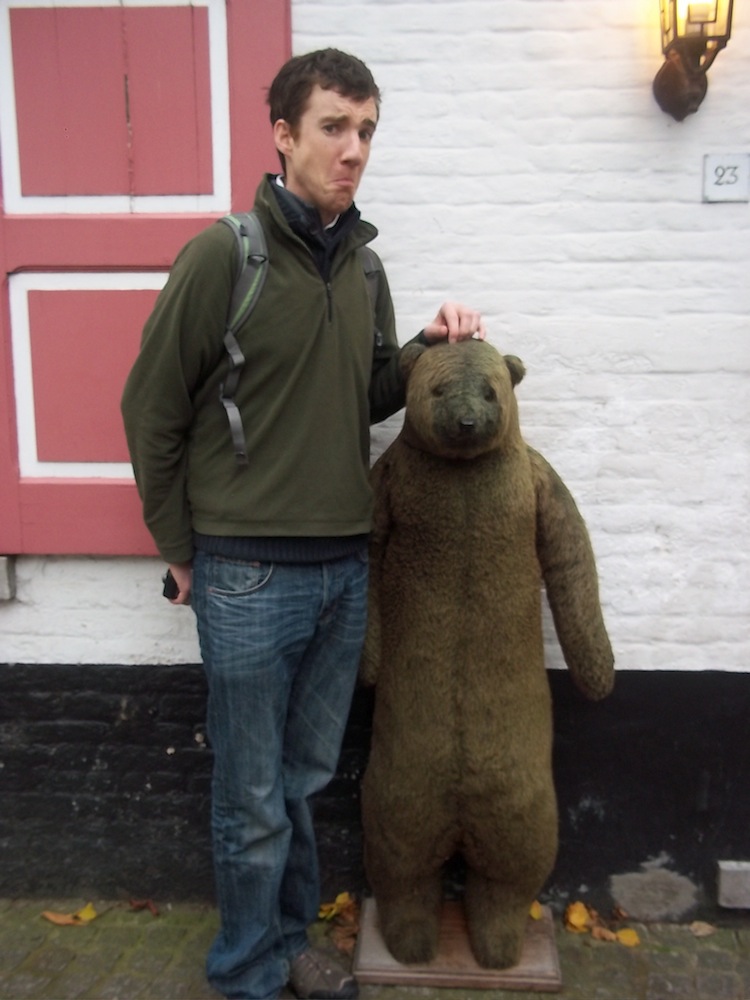
Me and a bear in Bruges

During November and December I wrote a paper on the experimental turbine work I'd been doing, and submitted it to the Journal of Applied Energy at the beginning of January. It was finally accepted in June, and published here in July! The paper that I presented at WREC was also published in Renewable Energy Journal in July this year as well, here.

A figure from the Applied Energy journal, the slug of water that's ingested by the turbine in one rotation

In the last weekend of November, Hannah and I went to Salisbury to celebrate two years. We had a fun couple of days and saw Stonehenge, the Cathedral, Avebury and the Uffington White Horse.

The Stone Circle at Avebury

I spent Christmas with my parents and sisters, which was great.

With my family at Mount Edgecombe

Back in the lab, I started working on an improved control system to try and reduce any current spikes when the two inverters connected together so that switches won't go bang when the inverters are connected to a grid. This improved control did what it was supposed to in the simulation.


Reduced current spikes on paralleling inverters

I had another family wedding in Ireland, my cousin Gillian got married in early February and Hannah and I headed over for the weekend. Unfortunately snow made our journey back delayed… (I blame Gillian's sister, Jenny, who flew back with us!)

Gillian and Alex's wedding

I found an IEEE conference in Kathmandu that would take place in late September, known as ICSET. I wrote two papers for this conference, one on the turbine testing and the other on a simulation of a off-grid pico hydro network, submitting them by the end of March, which were approved. I'm off to Nepal on the 17th September, which is going to be amazing.

A simple model of an off-grid pico hydro network

I also attended and presented at the EWB research conference at UCL at the end of March, adding to the stress at the time, but really enjoyed it and was interested to hear some of the other projects going on in the EWB universe.

AC grid with distributed generators connected with inverter front ends

After submitting the papers, Hannah and I went off to India for two weeks, and had the most fantastic time. We spent a week in Kerala and a week in Bangalore, and had some amazing experiences, spending a night on a houseboat, riding on an elephant, and visiting some beautiful parts of the countryside.

On a houseboat in Alleppey, Kerala

On returning from India, I started to build some electronics, starting with a simple inverter, four switches and an inductor-capacitor filter. I built a simple control circuit in analogue components to control the output current to a reference sine wave from a signal generator. The circuit managed to produce a relatively good output.

Inverter Mk1 and Output

At the end of April, Hannah and I went to see one of my favourite bands, Feeder, in Cardiff. They were absolutely amazing. Enough said.

At the Feeder gig

By the beginning of May, it was time to do 'Living Below the Line' again (see last years version here). We raised money for MRDF and this time, there were a good 10 of us that did it.

Pasta Dinner during Live Below The Line

Once the original inverter worked, I built a second checking it worked with the basic controller, and then used a real time controller called dSPACE which can use MATLAB models to control things, allowing quick changes to be made to the model and be able to see the result of it. Both inverters worked controlled by the dSPACE which was great.

Parallel Inverters with dSPACE

The Olympic Torch came to Bristol in May, and we went down to the Harbourside to see it. The city was buzzing, and we had a fantastic time watching it arrive.

Olympic Torch arriving in Bristol

I ran a quick tour of the Hydrolab for the University of Bristol's Open Day in June, and showed some of the potential new students around and demonstrated the turbine rig. By the end of the day, my voice was hoarse, but had talked to many hundreds of people.

Turbine rig running

Obviously with London holding the Olympics, I wasn't going to miss going to see some events. We went to see the Beach Volleyball on Horseguards Parade and some Hockey in the Olympic Park, just a most fantastic experience.

Beach Volleyball at Horseguards Parade

Once each of the inverters worked individually, I connected them together, to see how they would work in parallel. They synchronised without blowing up, which was always good, and now in my work I'm trying to improve the performance of the system.

Parallel inverters

Every year Bristol holds an International Balloon Fiesta in Ashton Court, on the outskirts of Bristol. We went to the Nightglow, where the balloons light up to music, and saw a mass take off with Tim, who had come over from New Zealand.

Balloons at the Nightglow

We had a few days in Cornwall, camping. It rained, well it was Cornwall after all, but had a few nice and sunny days, especially down on the Lizard and ate some rather tasty ice-cream too…

Lizard Lighthouse in the sunshine!

A couple of weeks later we returned to Cornwall for a school friend's wedding. Again it rained, and it didn't really let up this time. Argh. Still, we enjoyed an ice-cream in the rain.

Hannah eating an Ice-cream in the rain at Lanhydrock

As well as the Olympics, we also got some tickets for the Paralympics, this time for the swimming, athletics and also saw some judo and table tennis. If anything, we enjoyed this more than the Olympics, the atmosphere was just incredible.

The long jump in the Olympic Stadium

And straight from the Paralympics we headed to the Small is Festival 2012. I had been asked to do a little workshop on pico hydro, and so designed a workshop to build a little crossflow turbine and test it, the workshop went really well and I had a very inspirational weekend. And it didn't rain!

The workshop at Small is Festival

So, hopefully now you're all about caught up with me and my life. I'm really sorry it's taken so long to do this, but I hope I'll be a bit more regular. Not long to go with the PhD now either. Times are scary and fun!

SAM

Monday, 22 August 2011

Back to Nepal - Part 4 - Janai Purnima and Goodbye

I arrived back in the Kathmandu Valley in time for Janai Purnima. Janai Purnima is a time when Brahmin and Chhetri caste Hindus change their sacred thread, it is also when sisters give their brothers bands which they place around their wrists to protect them. Both Saru and Rachhu came to give me and Achut our bands.


The Rakhi that Saru and Rachhu gave to protect me

During this time there is a large festival in Gosainkunda lake in the Langtang Himalaya, where many people go to on a pilgrimage to change their Janai. In Patan, at the Kumbeshwor Temple a similar mela takes place. It is said that the temple is connected to the lake at Goskainkunda by an underground river, whether this is true is anyone's guess. So, I took a quick visit down to the temple with Mama's son, Subash.


Kumbeshwor temple at the Janai Purnima Mela

There were thousands of people at the temple, all wanting to visit the temple, pay respects to their gods and have a blessing from the priest and another thread rakish.


The idol from the temple in the middle of a chariot in a pool - the people were gathering the money at the bottom of the pool to give to the idol


The priests sitting outside the temple


Me and Subash

Janai Purnima is a family time too. Saru and Rachhu had come over from their respective new houses. It was great to see them as I would be leaving in a couple of days afterwards. Going this time was going to be a bit strange. Every time I have gone in the past then I knew when I was going to come back. This time, however, I didn't really know what was going to happen, in the next 2 years I would be needing to finish my PhD and then write up, so when I would be back I wasn't sure. So I made sure I saw as many people as possible in Kathmandu before I left.


Bob


Me and Bob


Krishna and me


Achut and me at the airport

It was a sad day leaving, Aama was ill again, I really couldn't answer when I'd be back next. Buwa gave me a tika and as quickly as I'd arrived it was going again.

SAM

Saturday, 20 August 2011

Back to Nepal - Part 3 - Learning Planet

Before I left for Nepal, I spoke with Arthur Williams, who had been conducting research in pico hydro for over 20 years. I had met Arthur a few times over the last couple of years and found him a great person to chat to and bounce ideas off. He had hands on experience of pico hydro systems and was always interested in improvements. He was supervising an MSc project looking at the feasibility of a pico hydro project in Gorkha district of Nepal for a charity called Learning Planet. Learning Planet was run by a former teaching volunteer and her friend in the UK, as well as the Nepali headmaster of a school in Gorkha district. They were looking at trying to improve the local school and community though educational projects. I was quite intrigued, on a pico hydro side, I had never really done any site studies and so wanted to look at different potential sites. On a more development side, some of the projects they were talking about doing were quite different for Nepal. So I decided to visit and see what was going on.


Bus from Pokhara to Gorkha

I took an early morning bus from Pokhara to Gorkha, the district headquarters. From there I caught a bus towards Arughat, a town on the Budi Gandaki river. Soon, a 600MW hydro power station would be built on this river, flooding 40 square kilometres of land and causing many families to be relocated. I'm never sure how I feel about large hydro, especially when land is flooded and people are forcibly relocated. Obviously, a reliable electric supply is invaluable to Nepal's development, and using their own hydropower they would not depend on imports of oil from India. However, there is a lot of research, for example here, which suggests the greenhouse gas emission from these lakes negates any gain compared to fossil fuel based power sources. I have also heard stories from places like Sarawak in Malaysia about large hydro projects not being thought through properly.

The road to Arughat was problematic. In the monsoons, the road had washed away in two places, so I had to change buses twice. Several times, the buses slipped and slid, getting closer and closer to the edge of the road. From leaving Pokhara at 6am, I got off the final bus at about 4pm, being met by two pupils of the Learning Planet school in Dhawa. We then walked for the next hour or so down the valley and then up the side of another hill to reach the village. By the time I arrived in Dhawa I was a sweaty mound, always a great way to meet new people! Sat outside the school was the Headmaster, an unassuming man called Giri Raj Lamichhane. We had tea, and chatted about the school. Another foreigner, a German who had been living towards Manaslu for the last couple of months, had arrived the same afternoon, and Giri took us back to his house for tea. We ate and chatted. Giri told me about his ideas and plans. He wanted to expand the school, currently there were 10 classrooms for 500 children, and they were just going to start teaching plus 2 - A Level equivalent - so needed more classrooms and teachers. As always, money was a problem. They had started to build some classrooms, but funds had run out. Giri seemed to have a different mindset to many that I had met in Nepal. He wanted to improve things by learning themselves, through education and knowledge transfer. It wasn't what I'd normally heard from people.


My two pupil guides to Dhawa


Dhawa

Over the next couple of days I began to really respect Giri. He had taken a lot on, and wanted to make his village a better place. His ideas didn't stop at the school, he wanted to help improve the water supplies, help continuity of electricity through micro hydro projects and help to keep talented people in the village by offering them opportunities there. He did seem to have the whole world on his shoulders though, I wondered if he was taking too much on himself.


The current nursery school


The main school buildings - solar panel provided by Learning Planet through the Envrion Foundation


The classrooms


Pupils clearing a field to do athletics on


Practising the long jump in the newly built pit

Giri took me to look at the river they would like to build the pico hydro. Even in the monsoon season, the flow seemed quite low, so again, my research would not be much use here. However, there was a good head drop, through a waterfall and so could use a small peltric set. There were a couple of possibilities for sources, two rivers in different locations. Arthur's MSc student was conducting the feasibility study for this, to see which would be most appropriate. It was good to try and look at the site and try to picture what it would look like. As it was a river, there was a point where I needed to wade, and being clumsy me, I did fall in the river, to a mix of concern and laughter from the locals that were accompanying us. I didn't damage anything too bad, although I managed to bash my toe and this went black for a good week.


The river for the pico hydro source

There are a couple of projects that Learning Planet are still undergoing, and require funding for. They are both building projects, the pictures are below. If anyone is looking for worthwhile and meaningful projects to support can I recommend these. You can donate here, on their website. They are also looking for teaching volunteers, schools to twin with and communicate with, so if you're interested please contact Learning Planet. I felt very at home in Dhawa, a very friendly little Nepali village, who want to improve all their lives.


Building the new classrooms


The new Nursery school, supported by Architecture for Humanity

The journey back to Kathmandu was as fraught as the journey to Dhawa. When I climbed aboard the bus after an hour's walk along slippery paths, the aisle was full of stones, which confused me. When we arrived at a particularly muddy section of the road, I finally understood. The kalashi (bus conductor) got out and filled in the muddy section with the stones, allowing the bus to drive over it. Again, I had to change buses twice. The final bus coming into Gorkha almost didn't arrive. There was no seating on the bus, so I had to stand in the aisle. The bus was baking, everyone had sweat dripping of their faces. The road had a particularly slippery section a couple of kilometres from Gorkha which the bus seemed unable to pass. We would slip and slide, but never get any further. After a long run up, we flew towards the mud and slipped and slid right to left, towards the edge of the road, which was followed by a drop of about 30ft or so, but the bus managed to squirm its way along the road, finally finding some grip and shooting forwards once again. After the excitement of the bus ride to Gorkha, the trip to Kathmandu was mundane, only a couple of occasions my pulse quickened where the bus overtook on blind corners where we were met by trucks on the opposite side of the road.

I had arrived back in time for Janai Purnima, and then after a couple of days I would leave for the UK.

SAM

Thursday, 18 August 2011

Back to Nepal - Part 2 - Rest and Relaxation

I finally arrived in Lalbandi in the late evening, it had taken me the best part of a day to reach there from Ilam, on 4 different buses and being squashed against several different strangers. Bhinajyu, Didi's husband, was waiting for me at the bus stop and I rode pillion on the back of his cycle the few kilometres back to their house in a village outside Lalbandi. They had finished planting their rice a week or so before and were now taking things a bit easier.


Didi's house, just outside Lalbandi


Didi's two sons, Bibek and Bipin - I did a lot of exploring with Bibek during my year in Nepal, see here

Lalbandi is in the Terai, the plains area to the south of Nepal. As such, during the monsoons it gets a lot of rain from the Himalaya above it, and when it's not raining it's roasting hot, normally 40 degrees celsius. I spent my few days in Didi's house sleeping and keeping out of the sun. It was great to just sit back and do very little, the walking in Ilam and then the bus journey had taken it out of my legs, they were not only aching a little, but bruised from the small seats.

When I arrived at Didi's house, Bhinajyu pointed at their buffalo and said that she was due to give birth any time soon. The pregnancy for a buffalo lasts about 11 months apparently, and they were now looking forward to getting some creamy milk. Even better, in the days immediately after the birth the buffalo produced a high colostrum  milk, bigauti in Nepali, which was very tasty. Obviously the calf would have to have some of the milk to ensure it had all the vitamins it needed, but the buffalo would produce too much, so we would have that.

A few days later the buffalo began looking more and more uncomfortable, and in the evening, just before tea after a very short labour the calf was born. It fell to the ground and crumpled in a heap. We waited. The calf didn't move. Was it still-born? The mother looked up at Bhinajyu, it was her first calf and she probably wasn't sure what was supposed to happen now. The calf eventually gave a little cough and came to life.


The calf minutes after being born, Bhinajyu cleaning it up

Bhinajyu rushed in and cleared the calf's mouth from the afterbirth. The buffalo then moved in an started to show a little motherly affection to the calf, before returning to its food. For the next few days the calf got stronger, stood up, walked and one day drank all the milk from its Mum. We ate the bigauti, which when boiled for a long time became quite sweet, and full of vitamins.

Monsoon season is also the time for snakes in the Terai. I had been warned for the last few times I had visited Lalbandi that I would have to be careful about snakes, but I still had never seen one. I wasn't sure if I would be scared to see a snake or not, but I was just very curious. So, one day Bibek and I went to look for snakes, and to visit their fields that were now full of sugar cane - ukhu in Nepali. The snakes would come out during the day as the sugar cane fields wouldn't provide them anywhere cool to lie, and they would lie on the pathways between the fields. I had heard there were snakes the thickness of my leg that regularly sat out.

Bibek took me out to their fields, and showed me a field with banana plants in. Apparently an elephant had come through here a couple of nights before and eaten some of the bananas - I could see some of the footprints it had made. Then we walked through the sugar cane, looking out for snakes. But as we emerged from the field, we had seen none. I was slightly relieved, but a little disappointed as well. I asked Bibek what he would have done if he had seen a snake, he said he would run, and I have a feeling that I would have done the same thing.


Bibek with the sugar cane (left) and bananas (right)

However, a day later my curiosity about what my reaction to snakes was fed as a snake made a dash towards the veranda of the house where Bhinajyu and I were talking. I wasn't scared, it was quite small and I heard the reassuring words in my ear "it's not poisonous".


The non-poisonous snake. But still a snake!

Then all too quickly it was time to leave, from Lalbandi I was heading to Pokhara, the main tourist area in Nepal outside of Kathmandu. I was in Pokhara to meet Narendra Limbu, the chairman of the Pahar Trust. The Pahar Trust is an NGO that develops schools and community health posts in rural locations in the hills of Nepal. It is supported greatly from the UK by the Rotary Club. During a presentation to the IMechE in Bristol in March a supporter came and talked to me about the possibility of putting pico or micro hydro into any of these sites to electrify them. So, I visited the office and had a good chat with them. Although my research I'm doing I don't think will be able to directly help them, I was able to put them in touch with some people that can, which was great. I looked over some of their projects, and they seem to do some fantastic work. They have completed over £1 million of projects now, and are still going strong. I spent the rest of the time in Pokhara near the lake people watching and avoiding the rain, which at times flooded the roads.


Phewa Taal in Pokhara

From Pokhara I was going to head to a new place for me, Gorkha district, to visit a school supported by Learning Planet that wanted to install a pico hydro set to power some lights in the school. Quite exciting!

SAM