How big is a bighas? (It is said big-a, the a as in apple). I honestly have no idea. I know it's an area of land, but what it relates to, I haven't the foggiest concept. So, when I visited a place called Chha-say (600) Bighas, near Rajghat in the Terai region of Nepal, I didn't know whether it would be the size of a large town or just 3 houses. We were going to Chha-say Bighas for a Sapta - a hindu celebration where religious stories are told by a priest - at Aama's sister's house. Aama had left the previous week to help them get ready for the Sapta, and Buwa and I were going to come along. I would stay for a day or two before returning to Kathmandu, whilst Buwa would then stay until the end of the celebration.
This would be my final farewell to the Terai. I had bought my ticket home. Money and time had run out. In 3 short weeks I would be heading back to the UK. My emotions were very mixed. I didn't really want to go home. Of course, I missed my friends and most of all my family in the UK. But I still hadn't achieved what I set out to do. Nothing had been accomplished in Rajghat - in fact now there was talk of the land now not being available for the health post. The work I had been doing with PEEDA on Low-head Pico Hydro units was at the proposal writing stage, trying to find donors. I didn't want to leave my friends who I had spent a year getting to learn about, their language, their culture, the way they survived from day to day. And for a lot of them, it was survival, nothing else. If anything helps you appreciate what you have, then it most certainly must be that.
Normally when going to the Terai, we take the morning Makalu bus. This time however, we were going to take the bus to Bharathba, a large village towards the Indian border, then walk the half hour or so to Chha-say Bighas. The problem was as we were going to a village, the bus wasn't going to be big or fast, but is was going to be packed. On taking a first look at the bus, I knew it was going to be one of those interesting journeys. They had obviously forgot that people required somewhere to put their legs as well as their backsides as when eventually I contorted myself in a reasonable sitting position my feet were off the floor and almost touching my bum. Combine this with my bag covering on what was left of my lap, and I immediately knew one thing - this was going to be uncomfortable.
As we left Kathmandu, I noticed one of the truths of Nepali life. As the buses' documents were being prepared to be given to a policeman a small pile of around 300 rupees was put inside. I watched as the policeman picked up the document, extracted the money and without looking handed the papers back. All the way along the route, money exchanged hands at several police posts, through a variety of methods. I thought the most ingenious was the loaded newspaper. Unfortunately, a reality of Nepali life is that many public servants get paid a pittance, and so need the bribes just to get by.
We stopped for food, and Buwa went off to get some apples to give to Samjhu, who we were hopefully going to meet at the bus park in Hetauda. (It was Samjhu's wedding I went to recently in Hetauda - click here). The bus all packed up and we waited for Buwa. 5 minutes went by, 10 minutes, 15 minutes, where had Buwa got to? Everyone on the bus thought that he had gone to get me food, as obviously I couldn't eat the same as a standard Nepali. The kalashi - conductor - eventually went down the road to find him, and after a further 10 minutes they both came back looking slightly flustered. Apparently, normally where they would sell apples, oranges and all sorts along the road side, they weren't today. Buwa had had to walk nearly 2 miles before he could find someone selling fruit. When we got to Hetauda we couldn't find Samjhu, and so all the waiting was in vain. Typical.
In Hetauda, we heard rumours of strikes further east on the highway. A child has been knocked over and the family were protesting wanting compensation. However, we carried on, ignoring the rumours. However, as we travelled further eastward, there were fewer and fewer vehicles passing us in the opposite direction. When we reached Chhandranigapur there were hundreds of trucks and buses parked up. This wasn't a good sign. We drove further along the road and eventually came to another queue. This was the queue waiting to get by the blockage. However, as this was Nepal, instead of being british about it and taking our place in line, we jumped the queue and went hurtling along the empty side of the road. At some points we had to leave the road to avoid other cars, but eventually got to the head of the line, where the protest was taking place.
In the middle of the road lay a body wrapped up in a sheet. Leaning over it was a distraught mother and father, their grief all too obvious to see, and a mob of people holding bamboo sticks and chanting. This was the way in New Nepal. Money ruled, if you kill my child I expect money from you and the government. If you don't give me it then I'll block the road until I get what I want. A real democracy? I'll leave that for you to decide.
This was going to be frustrating. The protest was taking place on the bridge between Sarlahi district and Bara. Once we crossed the bridge, it would only be a further 10 minutes to Bharathba. We reached the man who was in charge of the mob, and the kalashi negotiated our way through - telling the organiser we were all from this district. I hid. I guessed he would realise where I wasn't from. Somehow we got through, the first vehicles to get through all day. We were the drip that started the flood, and hundreds of lorries and trucks from both sides of the bridge tried to get through. When we arrived in Bharathba, it was just as I remembered it from 2 years previously. It was one of the places I had been most scared in Nepal, there were mobs of Madeshi going round and looking for trouble. When we got off the bus, a group of people surrounded us. They started asking questions: What is this white boy doing here? He doesn't belong here... Is he rich? Where is he from? Why doesn't he go back there? Although I couldn't understand all that was said, I got the gist - I wasn't welcome. One of the first times in Nepal I felt in the wrong place. However, Buwa and I started to walk off down the road, and the group dispersed. Maybe it would come to nothing.
We arrived in Chha-say Bighas after a half hour walk and found Aama's sister's house. It was a big house, all prepared for the celebration. I was given a seat and told to sit. Aama had obviously told them that I like sel roti - the round doughnut like bread - and yoghurt, as for the next 2 days I was constantly offered these both. The time I spent at the Sapta is a bit of a blur, I have to admit. The Sapta itself involved people sitting down and listening to a priest reading from the Hindu holy texts. As I was not a brahmin, or even a Hindu, I was not allowed in the holy area. However, I was allowed to watch and listen - not that I understood it at all.
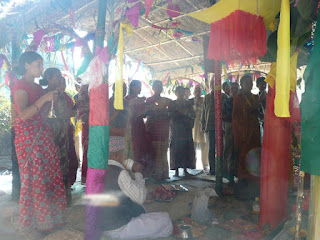
The Sapta
I met Jivan, Aama's nephew. Jivan, he proudly told me, was a member of the PLA - the People's Liberation Army. This scared me a little. The PLA were the Maoist's army, before the peace accord was signed 2 years previously. Now most of them were confined in camps around Nepal, with their weapons supposedly locked up. However, most believed that they had only given the UN monitors the weapons they didn't want. Jivan, however, seemed perfectly normal and was very friendly. Tentatively I asked him about cantonments and his time in the PLA, but he didn't want to say too much, so I left it there. I also met the rest of the family who were typical Nepali - really friendly and open, ready to welcome you into their homes and family.
I also met someone that the family called Mr Sir. Mr Sir was one of the forgotten refugees in Nepal. Everyone knows about the Tibetans that escaped China and live around Kathmandu, but many forget about the Bhutanese refugees, even though there are many more of them, over 100,000. In the early 1990s, Bhutan in an effort to protect its culture began a process of ethnic cleansing, and threw out all Bhutanese of Nepali descent. These people had been living in Bhutan for generations, but if they could not prove this, then they were forcibly removed. These people, left without a home returned to Nepal, and were put in refugee camps in the far east of Nepal. Slowly, the refugees are being relocated in the USA and other countries, but many of them just want to go home to Bhutan. I shared a room with Mr Sir, when i say shared a room I took his bed, and slept on the ground. Did I feel guilty? Oh yes...


A walk around Chha-say Bighas
One day, I went for a walk around the village with some of the kids in the family. They showed me their schools and we walked through the fields. They asked about life in the UK. Their questions were not quite what I was expecting - even after almost a year in Nepal. What work did I do in my office? How did I get to the office? Who cooked in my house? When I thought about it afterwards, I think they were just trying to get the idea of what life was like outside Nepal. I tried to make sure that I answered truthfully, without rose-tinted glasses or cynicism.
We sat down in a little bandstand built by the community. There was something slightly different about this though - it was covered in Maoist symbols. There was the PLA logo printed on one of the posts, a picture of Prachandra - the Maoist leader - on another, and photos of when the bandstand was opened. To be honest, it was just a bit odd, I didn't really feel comfortable there. However, there was something good about the way the community came together to build it, spend almost a thousand pounds to do it. Maybe community spirit wasn't dead.
I left Chha-say Bighas after a couple of days and headed to see Didi and Bhinajyu outside Lalbandi, with Buwa. This involved a walk into Bharathba and a bus then, for my first time in Nepal, a ride in a Tempo - the three wheeled rickshaw. The tempo journey was probably the most uncomfortable thing I have ever done. To fit in the back, I had to be bent double, sat on metal bars, and then on every bump in the road I hit my head on the metal bars on the roof before returning to earth onto the metal bars beneath my rear end. To add to the comfort, there was very little room to breathe in the back of the rickshaw, people and goats my fellow passengers occupying all available space, and being choked by the fumes from the exhaust. Fortunately before asphyxiation set in we gracefully extracted ourselves and walked to Didi's house.
It was time to say goodbye to Didi. I enjoyed being with Didi, she worked hard and had great dreams for the future. That was something I admired, she had a vision for the future, how to make her life better, how to improve things for her family, and she wasn't afraid to work hard to achieve it. That attitude could teach us all a lot.
I said my goodbye, and finally was allowed to do something I had wanted to do for a long time in Nepal - travel alone. From Lalbandi, I took the bus to Hetauda and then from Hetauda caught the Jeep to Kathmandu. In Hetauda I tried to find Samjhu, whose new husband's shop was along the high street somewhere. However many times I walked along the high street though, I couldn't find it. It was a shame, as I wanted to see Samjhu too before I left.
Preparing to say goodbye was hard. I arrived back in Kathmandu and knew there were so many people that I wanted to see in the next 2 weeks. How was it going to happen?
SAM


 Turgo Wheel
 Crossflow